
Photovoltaic Panels
The are 3 basic types of construction of PV panels though all use silicon.
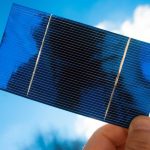
Monocrystalline cells are cut from a single crystal of silicon- they are effectively
a slice from a crystal.
In appearance, it will have a smooth texture and you will be able
to see the thickness of the slice.
These are the most efficient and the most expensive to produce. They are also rigid and
must be mounted in a rigid frame top protect them.
Polycrystalline (or Multicrystalline) cells are effectively a slice cut from a
block of silicon, consisting of a large number of crystals.
They have a speckled reflective
appearance and again you can you see the thickness of the slice.
These cells are slightly less efficient and slightly less expensive than monocrystalline
cells and again need to be mounted in a rigid frame.
Amorphous cells are munufactured by placing a thin film of amorphous (non crystalline)
silicon onto a wide choice of surfaces.
These are the least effient and least expensive to produce of the three types. Due to the
amorphous nature of the thin layer, it is flexible, and if manufactured on a flexible surface,
the whole solar panel can be flexible.
One characteristic of amorphous solar cels is that their power output reduces over time,
particularly during the first few months, after which time they are basically stable. The
quoted output of an amorphous panel should be that produced after this stabalisation.